
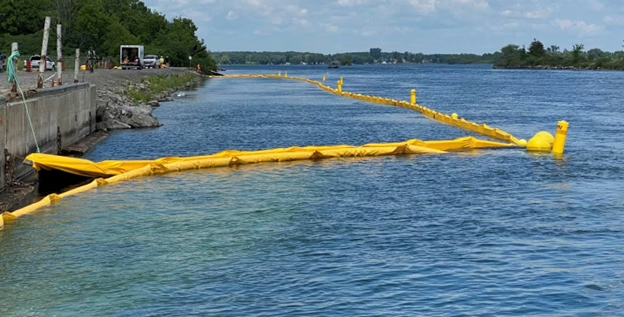
Canadians are lucky to have so many bodies of water. Canadians use these waters for activities like travelling, kayaking, and boating, but keeping them open for public travel requires a strong regulatory framework. That’s where the Canadian Navigable Waters Act (CNWA) is introduced. This act plays a critical role in managing development and activities that could impact the public’s right to navigate these essential natural resources. Between shifted schedules, major project classifications, and updated environmental rules, navigating federal water laws can feel overwhelming. In this blog, we will discuss how the CNWA works, who is required to comply, and why it affects almost every shoreline project.
The history of this legislation dates back over a century, with a few changes to the name. Its predecessor, the Navigable Waters Protection Act (NWPA), was first enacted in 1882. Over the decades, the act underwent various changes to adapt to changing societal needs, environmental concerns, and legal clarifications.
The most significant change occurred when the NWPA was amended and renamed the current Canadian Navigable Waters Act, which was enforced on August 28, 2019. This transition marked a substantial shift in the approach to protecting Canada’s waterways.
The primary purpose of the Canadian Navigable Waters Act is to protect the public rights of navigation in all navigable waters throughout Canada. This means ensuring that waterways stay accessible and usable for all forms of navigation, from recreational boating to commercial shipping, without being obstructed or hindered by new works or developments.
The CNWA’s creation in 2019 was a response to widespread public and Indigenous concerns that the previous NWPA had been weakened, leading to insufficient protection for many waterways. The new Act aimed to restore and enhance these protections.
The federal government, specifically Transport Canada, is responsible for the overall administration and enforcement of the Act. This includes developing regulations, guiding users through the review process, and ensuring compliance.
Expanded Scope of Protected Waters
One of the most significant changes introduced by the Canadian Navigable Waters Act was the restoration of protections for navigation on all navigable waters in Canada. Under the earlier legislation, protections had become more focused on navigable waters specifically listed in a schedule. The CNWA now provides a framework that applies to both scheduled and non-scheduled navigable waters.
Understanding Minor Works, Major Works, and Scheduled Waters
The requirements under the CNWA depend on the type of work being proposed, the navigable water where the work will take place, and whether the work is likely to interfere with navigation.
Minor Works
Certain projects are classified as minor works because they are likely to have little or no interference with navigation when established criteria are met. Examples may include certain docks, aerial cables, pipelines, and other structures that meet the requirements set out in the Minor Works Order. These works generally do not require an individual approval under the CNWA, provided all applicable criteria and requirements are followed.
Major Works
Major works are projects that have a greater potential to interfere with navigation. They are identified under the Major Works Order and can include certain large-scale structures such as dams, bridges, causeways, and other significant infrastructure. A major work that may interfere with navigation requires an application to Transport Canada’s Navigation Protection Program, regardless of whether it is found on a scheduled or non-scheduled navigable water.
Scheduled Navigable Waters
Scheduled navigable waters are waterways specifically listed in the Schedule to the CNWA. These waters receive more oversight under the Act. For works that are neither named minor works nor major works, an application for approval may be needed when the work is found on a scheduled navigable water and may interfere with navigation.
Non-Scheduled Navigable Waters
Non-scheduled navigable waters are navigable waters that are not specifically listed in the Schedule to the Act. They are still protected under the CNWA. Depending on the type of work and its potential impact on navigation, users may need to follow processes such as providing public notice, trying to resolve navigation-related concerns, or applying to Transport Canada for approval.
Understanding these distinctions is important because being found on a non-scheduled water does not automatically mean that a project is exempt from the CNWA. The requirements depend on both the classification of the work and its potential to interfere with navigation.
Modernized Review and Approval Processes
The CNWA introduced updated processes for reviewing works that may interfere with navigation. Depending on the project, Transport Canada may review an application, establish terms and conditions, and require public notification or consultation. These processes are intended to find and address potential impacts on navigation before a project proceeds.
While the primary focus remains navigation, the CNWA broadens the scope of considerations during project reviews. It requires decision-makers to consider the public interest, which includes factors like:
• The safety of the public
• The impact of the work on the environment
• The impacts of the work on Indigenous rights
• Any relevant information provided by Indigenous groups or the public.
This approach ensures that decisions are not made solely on navigational impacts but consider a wider range of implications.
The Canadian Navigable Waters Act applies broadly to anyone proposing to conduct work in, on, over, under, or through navigable waters. This includes:
- Individuals: For example, someone building a private dock or a small bridge on their property.
- Companies and Corporations: Developers, resource extraction companies (mining, oil and gas), construction firms building infrastructure like bridges, pipelines, or transmission lines.
- Indigenous Communities: When undertaking community infrastructure projects that interact with navigable waters.
- All Levels of Government: Federal, provincial, and municipal governments conducting public works such as constructing roads, bridges, or wastewater treatment facilities.
The responsibility for administering and enforcing the Canadian Navigable Waters Act rests with Transport Canada. Within Transport Canada, the Navigable Waters Protection Program (NWPP) is the specific unit tasked with managing the application of the Act.
- Guidance and Advice: Providing information and guidance to people on how to follow the Act.
- Review and Approval: Processing applications for works, conducting assessments, and issuing approvals or imposing conditions.
- Public Engagement: Facilitating public notification and input processes to gather public feedback.
- Compliance Monitoring: Monitoring works to ensure they are built and used following approvals and the Act.
Transport Canada has appointed Enforcement Officers who oversee ensuring compliance with the CNWA. These officers have the powers to investigate potential violations, which may include inspecting sites, requesting information, and interviewing individuals.
When a violation occurs, or there is a risk of one, enforcement officers can take various actions, including:
- Issuing Warnings: For minor infractions.
- Issuing Orders: Requiring a person to take specific actions, such as ceasing work, modifying it, or removing an unauthorized obstruction.
- Putting Administrative Monetary Penalties: Fines for non-compliance that can be issued without a court conviction.
- Recommending Prosecution: For more serious or repeated offences, leading to charges under the Act.
Indictable Offence: For more serious offences, individuals can face fines up to $500,000 and/or imprisonment for up to three years. Corporations can face fines up to $5,000,000.
Orders to Remove or Modify: Beyond financial penalties, the Act allows Transport Canada to order the removal or modification of any work that obstructs navigation or was built without authorization. If the owner does not comply, Transport Canada can undertake the removal or modification itself and recover all associated costs from the owner.